



Your next breach isn’t waiting for a hacker. It’s waiting for that security role you’ve had open since Q1.
Right now, there are 4.8 million cybersecurity jobs open worldwide. Attackers know you’re trying to hire cybersecurity talent. And honestly? They’re counting on it. They go after organizations in the middle of hiring, when defenses are stretched thin, and no one’s quite sure who’s covering what.
Here’s the thing: the talent is out there. The problem is almost always the process!
So here’s a step-by-step guide to fixing yours in 2026.
Why Hiring Cybersecurity Talent Feels So Hard Right Now?
The global cybersecurity workforce solutions need to grow by 87%. Most people assume that means there just aren’t enough people to hire. But that’s not really THE problem.
These days, the biggest obstacles are economic pressure and broken internal hiring processes. This includes:
- vague job descriptions,
- slow pipelines,
- roles that stay open for months while your team runs on fumes.
The cost? Real.
An understaffed security team doesn’t just struggle; they end up paying, on average, $1.76 million more in breach damages than a fully staffed team.
Fix the process first, and everything else gets a whole lot easier.
Step 1: Define the Role Before You Post It
Most cybersecurity job descriptions fail before a single candidate reads them. They either demand a unicorn, ten years across five disciplines, or they’re so vague that the wrong people apply and the right ones scroll past. Before writing a word, get your security leadership to answer three questions:
- What specific gap or threat does this hire solve?
- Do we need someone who can jump on an active attack at 2 a.m., or someone who builds the systems and policies that keep attacks from happening in the first place?
- And be honest, are we quietly looking for a cloud architect, a DevSecOps engineer, and a pentester, all wrapped into one job description?
Write outcome-based descriptions. Instead of “5+ years in cybersecurity,” try “able to independently lead SOC triage and reduce mean time to respond within 90 days.” Poorly defined roles:
- slow hiring,
- increase mis-hires, and
- leave critical security functions exposed.
Once you actually know what you’re hiring for, the next question is where and how you go to find them. This is where most teams stumble.
Step 2: Build a Smarter Cybersecurity Recruitment Strategy
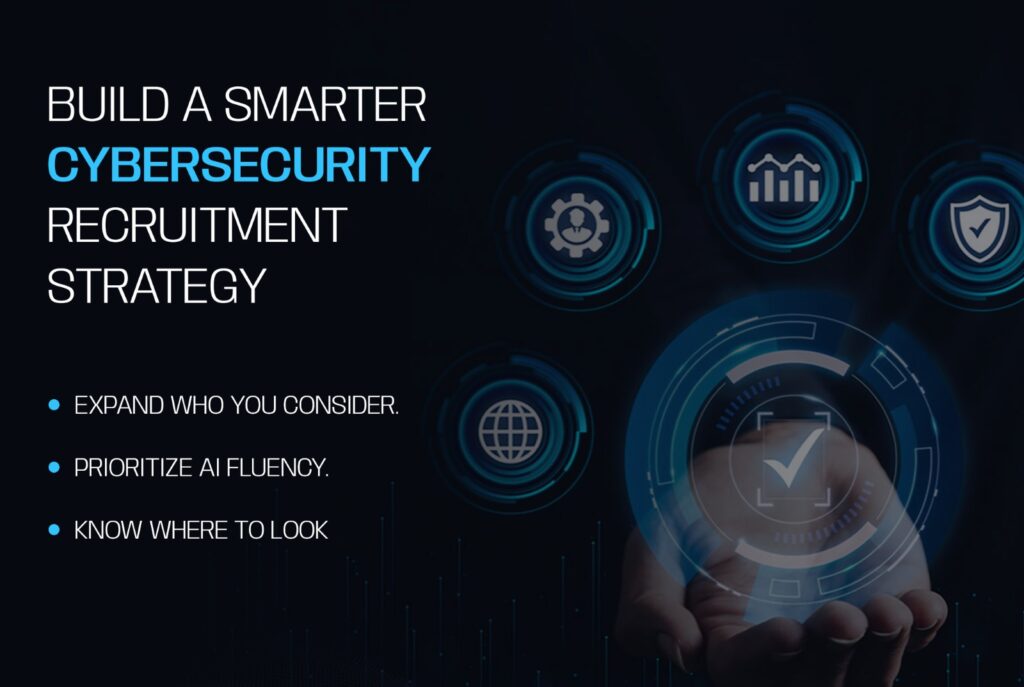
Where you look for candidates, and how you reach them, matters just as much as getting the job description right.
Expand who you consider.
90% of hiring managers only consider candidates with previous IT experience, but people transitioning from networking, system administration, and software development make strong security professionals. Broadening your lens means access to a talent pool your competitors are ignoring.
Prioritize AI fluency.
AI has officially become the most in-demand skill in cybersecurity. 41% of employers say it’s their top need, beating out cloud security for the first time. Look for candidates who get it: people who understand how attackers are weaponizing AI and, more importantly, know how to defend against it. Those are the ones already a step ahead.
Know Where To Look
LinkedIn is not the only source where your candidates actually are. You can also find them at:
- CTF platforms,
- ISACA and ISC2 communities,
- university cybersecurity clubs, and
- open-source security projects on GitHub, etc.
Getting the sourcing right brings better candidates in. The question is how to evaluate them once they’re there.
Step 3: Evaluate Candidates the Right Way
Resumes tell you what someone has done. They rarely tell you what someone can do under pressure. The most effective evaluation combines:
- Practical assessments: scenario-based tasks like analyzing a suspicious log file.
- Behavioral questions: how they’ve handled a breach, a disagreement with leadership.
- Communication fit: the ability to explain risk clearly to a non-technical CFO is a real skill.
Don’t let a checkbox kill a great hire. CISSP carries a 22–35% salary premium, but plenty of high-performing security professionals are still working toward it.
Finding the right person is tough. But keeping them? That’s a whole different challenge, and one most organizations don’t see coming.
Step 4: Hold Onto the Talent You Worked So Hard to Hire
People leave when they can’t see where they’re headed. Give them a path, or someone else will.
Career growth ranks as the #1 motivator for cybersecurity professionals at 28%, while salary is the number 2. Build an environment worth staying in:
- Upskilling sponsor certifications and training. Organizations that do see 70% fewer security incidents.
- Flexibility, unnecessary office mandates cost you candidates, before they even apply
- Purpose let your team see the real-world impact of their work, not just a queue of tickets
When hiring needs to move faster than your internal process allows, a specialized partner is the answer.
Step 5: When to Work With a Cybersecurity Staffing Agency
Sometimes the fastest way to hire cybersecurity talent is to stop trying to do it alone. When internal processes stall, recruiting timelines can drag on for three to six months. That’s not a delay, that’s a risk.
A specialized cybersecurity staffing agency cuts that window by bringing what most teams don’t have:
- a pre-vetted talent network,
- accurate compensation data, and
- the ability to move fast on niche roles like cloud security architects and threat intelligence analysts.
Not sure where to start? These are the questions we hear most from teams just like yours.
Frequently Asked Questions
Q: How long does it actually take to hire for a cybersecurity role in 2026?
On your own, with a typical internal process? Anywhere from three to six months. That timeline shrinks fast when you use skills-based hiring, speed up your interview steps, or bring in a specialized cybersecurity staffing partner.
Q: What cybersecurity skills matter most right now?
AI literacy is number one in 2026, followed by cloud security, threat detection, and incident response. Look for candidates who know how to work with AI tools, on both the offensive and defensive side, rather than someone who just has the longest list of certifications.
Q: Do cybersecurity candidates still expect remote work?
It’s not really a perk anymore; it’s the norm. Only 6% of cybersecurity professionals want to be in the office full-time. If your policy is rigid, you’ll lose good people before they even interview.
In Sum
The organizations winning at cybersecurity hiring aren’t the biggest. They’re the fastest and the clearest. Every day a role sits open is another day your defenses are thinner than they should be.
Start with the process and close with an exceptional cybersecurity recruitment strategy.
Hire cybersecurity talent with SOAL Technologies now!
Need the right talent for your team?
Partner with Soal Technologies to access data-driven recruitment solutions that connect you with skilled professionals quickly and efficiently.
Book a Free Consultation