



You budgeted for an IT hire, then the quotes came in, and none of them matched what you expected. In fact, most companies underestimate developer hiring costs by 40–70% once hidden expenses are included.
That gap between expectation and reality is one of the most common frustrations in IT staffing.
IT staffing costs aren’t just about the salary. They’re payroll taxes, benefits, agency margins, onboarding time, and financing risk all bundled into a number that rarely gets broken down clearly.
This blog unpacks each of these components so you can understand what truly drives hiring decisions in 2026, and get full clarity on your actual hiring developer cost.
The Truth About IT Staffing Costs (That No One Explains)

Most hiring managers compare what an agency charges per hour to a full-time salary, and that’s where the confusion begins. It seems straightforward: if you’d pay $110K for a full-time hire, why does a staffing agency charge $90–$115 per hour?
The answer is that the hourly bill rate isn’t just the worker’s wage with a markup on top. IT staffing firms typically net around 5% of revenue. That makes it a low-margin business, closer to traditional services, and far below industries like software or banking. The gap between the pay rate and the bill rate is made up of real, unavoidable costs that most clients never see.
And those costs add up quickly:
- Payroll taxes (12–15%),
- Benefits (another 8–10%),
- Financing (paying contractors weekly while waiting 30–90 days for you to pay), and
- All the unfilled roles.
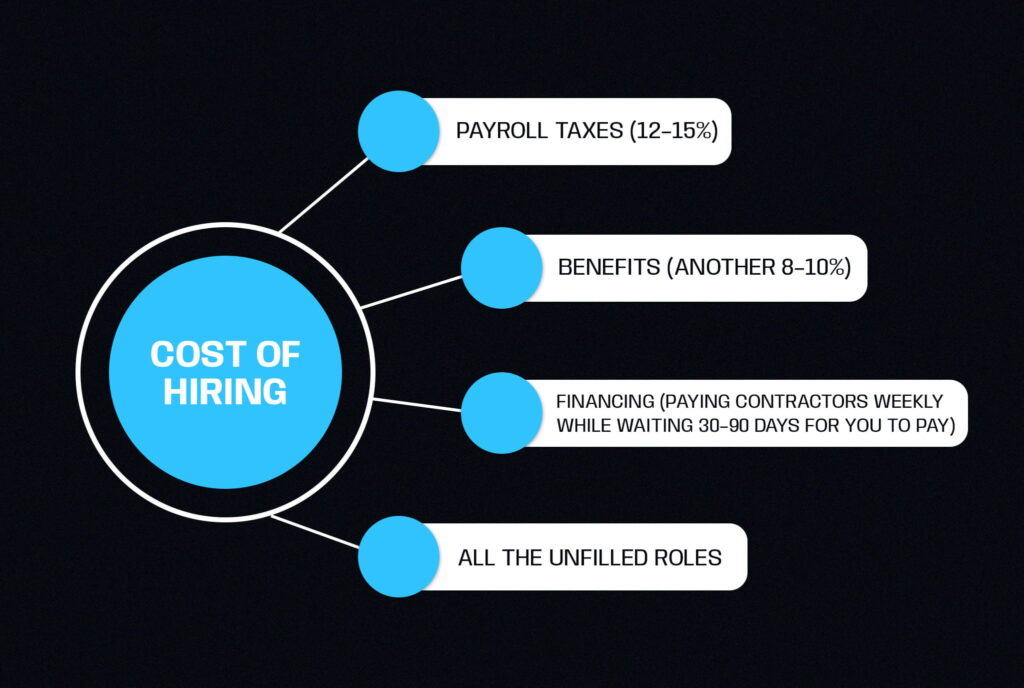
Staffing firms typically fill only 5–30% of the roles they work on. That means a significant portion of their effort generates no revenue, and pricing has to account for that.
None of this is hidden to mislead you; it’s simply how the model works. But once you understand it, you stop reacting to the price and start understanding the value behind it.
How IT Staffing Costs Vary by Role (2026 Guide)
The honest answer is that it depends on the role, seniority level, and the location of the talent. But there are real benchmarks worth knowing.
For US-based onshore talent, hourly rates in 2026 generally break down like this:
- Junior Developer: $40–$65/hr onshore, $20–$35/hr offshore
- Mid-Level Developer: $65–$100/hr onshore, $30–$55/hr offshore
- Senior Developer: $100–$160/hr onshore, $55–$90/hr offshore
- DevOps Engineer: $90–$150/hr onshore, $40–$85/hr offshore
- AI/ML Specialist: $120–$200/hr onshore, $60–$120/hr offshore
- Cybersecurity Specialist: $110–$180/hr onshore, $50–$100/hr offshore
These figures serve as a starting point for enterprise budgeting; actual costs vary based on team size, specific skill requirements, and the engagement model you choose.
Geography is the single biggest lever. Companies that hire offshore or nearshore talent commonly save between 40% and 70% on labor costs compared to local hires, a gap that compounds quickly across a team of any meaningful size.
The Pricing Models Behind IT Staffing Costs
IT staffing cost isn’t just about the hourly rate; how you structure the engagement matters just as much. The three main models in 2026 each fit a different need:
Hourly Rates/T&M (Time & Materials):
Best for shifting requirements or unclear scope. You pay only for time worked, but costs are harder to predict.
Monthly Retainer/Dedicated Team:
Great for long-term work. Predictable cost, and the team builds deep knowledge of your product over time. There’s a downside to it: you pay even in slow weeks.
Fixed or Project-Based Pricing
The fixed price model gives you budget certainty for well-defined, contained pieces of work. The tradeoff is rigidity; any scope change triggers re-negotiation, and vendors often build a risk buffer into the price to protect themselves.
Choosing the wrong model is one of the most common reasons companies overspend on tech recruitment costs. Not because the rates were bad, but because the structure didn’t match the work.
Beyond the model itself, hidden costs often arise from misaligned expectations, poor communication, or scope creep (ever-growing project scope) – and the right pricing model can expose them for you.
The Hidden Costs That Don’t Show Up on the Invoice
Every IT staffing cost comparison needs to account for what doesn’t appear on the first line of a quote.
Onboarding Delay Cost
Onboarding takes real time. A new contractor doesn’t hit full productivity on day one; there’s a ramp-up period for every codebase and team culture, and that time has a cost whether you’re tracking it or not.
Compliance and Security Cost
Compliance and security add complexity when working with international talent. Data protection requirements, cross-border tax obligations, and legal frameworks around intellectual property all require attention, and that attention costs money if you’re not prepared for it.
Scope creep is why so many projects quietly blow the budget. A new integration here, an extra feature mid-sprint there, legitimate costs, but painful surprises when you don’t draw a clear line. The best vendors draw that line upfront. Ask the question early, and you’ll see way fewer surprises on your invoice.
What Actually Drives IT Staffing Costs
Seniority And Speed
Tech recruitment costs go beyond the hourly rate. Senior developers charge more, but they work faster and need fewer revisions. Sometimes one senior ends up cheaper than two juniors.
Tech Stack & Specialization
Technology stack matters too. Common languages like JavaScript carry standard rates. Niche specialisms in AI, machine learning, or cybersecurity carry premiums everywhere, even in lower-cost regions.
An AI specialist in India, for example, can charge well above the regional average for general developers, because the demand is global regardless of location.
Contract Length Leverage
Contract length moves the needle on tech recruitment costs. Short gigs cost more per hour, and onboarding eats up a bigger slice. Longer commitments get you a discount; vendors trade a lower rate for steady, predictable revenue.
Finally!
The cost of IT staffing solutions is never just a number on a proposal. It depends on role, seniority, location, engagement model, and contract duration. Then there are operational costs like onboarding, compliance, or tool access.
Most clients don’t see those until they ask about overhead, utilization, or scope terms. In 2026, smart companies don’t chase the lowest rate; they understand what they’re buying. Pick the right pricing model and avoid surprises.
This is what we do. SOAL Technologies analyzes, compares, and assists you in hiring the best IT experts for your company.
FAQs
Q1: Why do IT staffing rates vary so much between agencies for the same role?
The rate isn’t just the developer’s pay; it’s the whole cost of finding, placing, and managing them. Better benefits, deeper vetting, and smarter financing cost more. Cheap rates usually just mean they’ve shifted the risk onto you.
Q2: Is offshore IT staffing actually worth it, or does quality suffer?
Yes, it’s worth it. The savings are real and significant. Most quality gaps come down to poor onboarding and unclear expectations, not a lack of talent. Give offshore teams the right setup and a few months, and they’ll match onshore standards every time.
Q3: How can SOAL Technologies help us figure out the right IT staffing model for our needs?
We look at the real work, not just the title. Then match you to the right model, based on your timeline, budget, and goals. Not just the easy quote.
Need the right talent for your team?
Partner with Soal Technologies to access data-driven recruitment solutions that connect you with skilled professionals quickly and efficiently.
Book a Free Consultation