



Offshore staffing has become a serious strategy for modern enterprises, allowing access to global talent and lower costs. In contrast, onshore staffing still has its place for close collaboration and regulatory needs.
This makes the offshore vs onshore staffing question a key decision for any business.
What Is Offshore IT Staffing, And How Is It Different From Onshore?
Onshore vs Offshore: What’s the Difference?
Alright, here’s the thing. Onshore staffing means hiring local people who live in the same country as your company. The big perk? You can actually talk to them in person, swing by their desk if needed, and overall, it just feels easier to keep tabs on what’s going on. This close‑by setup also helps with faster communication and fewer time zone headaches.
Offshore staffing? That’s when your team is somewhere else. Could be India, the Philippines, Poland, Colombia, really anywhere you can find talent. They work remotely, which is great for saving money, widening the talent pool, and scaling quickly.
So, when do you pick what? Onshore is good if you need a lot of in‑person meetings, tight compliance, or want to keep a close watch. Offshore services make sense when the work can mostly be done online, costs matter, and you’ve got a system in place to manage people from a distance.
This is where a solid IT staffing cost comparison becomes essential for making informed decisions.
The Real Cost Comparison
Cost is usually the first thing people look at. And yes, the difference is huge.
In the US, onshore IT rates often sit between $100 and $150 an hour. Offshore rates in countries? $20–$40 an hour.
But the hourly rate isn’t the full picture. Benefits, taxes, hiring fees, office space, and turnover all matter too.
Here’s a realistic Year 1 example for a mid‑level developer:
- Onshore: ~$244,500
- Offshore: ~$97,400
That’s roughly 60% in savings. Over three years, that difference can top $419,000 per person. Have four developers? You’re looking at more than half a million saved, money you could invest in better tools, hire extra people, or just have a safety net.
Offshore IT staffing can cut your annual per-developer cost by 55–70%, but it’s not savings across the board; legal setup and management overhead actually cost more offshore. Factor those in before making the call.
Cost category |
Onshore (US) |
Offshore |
Savings |
| Salary & benefits | $130,000 – $170,000 | $22,000 – $38,000 | ~75% lower |
| Hiring & onboarding | $21,000 – $33,000 | $4,500 – $11,000 | ~70% lower |
| Office & equipment | $8,000 – $14,000 | $500 – $1,500 | ~90% lower |
| Legal & compliance | $500 – $1,500 | $2,000 – $5,000 | Higher offshore |
| Management overhead | Minimal | $3,000 – $6,000 | Added cost |
| Total Year 1 estimate | ~$159,500 – $218,500 | ~$32,000 – $61,500 | 55–70% savings |
ROI Comparison: Offshore vs Onshore

Saving money is good, but the bigger question is: what do those savings actually do for your business?
- Hybrid model (onshore leadership + offshore development) → ~285% ROI
- Fully offshore team → ~387% ROI
- All‑onshore → ~145% ROI
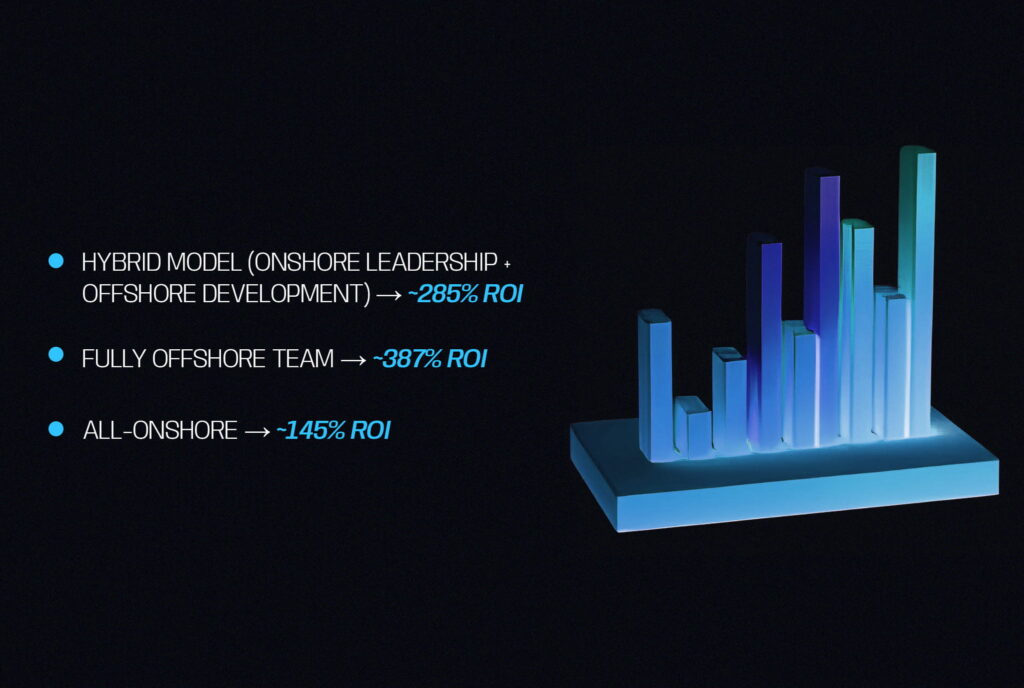
These figures reflect how businesses are increasingly mixing staffing strategies, pulling strength from global teams while still keeping local control where it matters.
Important note: these numbers aren’t magic. You need proper onboarding, clear expectations, and ongoing oversight. If you skip those, the ROI can tank.
Quality, Risks, and What Could Go Wrong
Taking risks is mostly a better option when you know you can manage it, so giving the work to people offshore won’t cost much, when the outcome is better than expected, or evens out.
Early quality may be slightly inferior in the first few months, but many firms see this gap close dramatically over time as remote staff settle in and systems evolve.
The tricky part isn’t usually the work itself; it’s the logistics. Time zones, minor miscommunications, and expectations that don’t quite align can cause most of the headaches. Teams that block a few hours to overlap each day, actually plan onboarding, and write things down tend to get things running smoothly much faster.
Compliance adds a layer too. Data protection laws, international regulations, and differing security standards need attention. Not deal‑breakers, just things you need to plan for.
When Onshore IT Staffing Makes More Sense
Offshore is not always the best option. Keeping things local can be worth the extra cost. Onshore is usually better when:
- You’re dealing with sensitive data under strict domestic rules (healthcare, government, finance)
- You need real‑time collaboration every day
- Your client insists on local staff
- Work requires local knowledge or face‑to‑face interactions
- Your team is small, and offshore management eats up all your savings
Healthcare, legal, insurance, and finance industries often favor onshore because regulatory and security concerns outweigh cost savings.
The Hybrid Model: Getting the Best of Both
Companies use hybrid models all the time, not fully onshore or fully offshore; they naturally land somewhere in the middle.
It’s simple: keeping client‑facing people and project leads nearby, and letting the offshore team handle technical work is how it usually works. You still have someone local for alignment and quick decisions, but you’re not limited in hiring.
Most teams set it up pretty straightforwardly: one or two onshore leads, and a small offshore team doing development, testing, and heavy lifting. It works because it’s flexible.
Hybrid staffing models that combine local oversight with global delivery are becoming more common as businesses look for both agility and control.
FAQs
Q1: Is offshore IT staffing really worth it for smaller companies, or is it mostly for big enterprises?
It used to feel like something only big companies could manage. But smaller companies are doing it now. It’s not as hard as you think; payroll, legal stuff, and admin are often handled for you. Hiring one person offshore can make a noticeable difference.
Q2: How long does it take offshore teams to achieve onshore performance levels?
Communication and workflow require some adjusting to. But give it time. Teams typically settle in and feel at ease after 5-6 months, which corresponds to real-world industry observations of offshore onboarding durations.
Q3: What’s the biggest mistake companies make when choosing between offshore and onshore staffing?
According to hourly rates, the number doesn’t tell the full story. Hiring speed, management effort, and ramp‑up time matter just as much. If you only look at cost, you might make the wrong call. Think long‑term and rely on a proper offshore vs onshore staffing strategy along with an accurate IT staffing cost comparison.
Conclusion:
Look, offshore IT staffing saves you serious money, often 60% or more. But don’t ignore the headaches:
- time zones,
- miscommunication, and
- compliance costs.
Onshore is pricey but great for sensitive work. The sweet spot? A hybrid setup: local leads with offshore builders. Keep it simple, plan, and you’ll get solid ROI without losing your mind. And if you need help figuring it all out, you can hire pros like SOAL Technologies, an IT recruiting agency, to have it all sorted out for you.
Need the right talent for your team?
Partner with Soal Technologies to access data-driven recruitment solutions that connect you with skilled professionals quickly and efficiently.
Book a Free Consultation