


March 2020 work-from-home was supposed to last two weeks. Five years later, 29% of all paid workdays in America are still happening from home. The office didn’t bounce back; work itself changed forever.
SOAL Technologies lived this shift from the inside. Five years are long enough to stop calling it an experiment.
Here’s what the remote work evolution actually delivered, and what it didn’t.
What Actually Changed
The Commute Disappeared and People Moved on
For millions of workers, the daily commute was one to two hours each way. That time went somewhere else: exercise, sleep, less chronic stress.
Research consistently shows that the ability to work remotely increases productivity. This improvement is proportional to an increased quality of life. Cutting the commute is a big part of it.
Flexibility Became a Baseline, Not a Bonus
Before 2020, working remotely was that thing companies let you do if they really had to. A favor, almost. Nobody’s going back to that. Right now, roughly 98% of professionals say they want to work from home at least part-time for the rest of their careers.
And around 57% even say they’d actually start looking for another job if that option went away. That’s more than half. Not because people don’t want to work. They do. They just don’t want to give up the kind of life that a little flexibility gives them.
So here’s where we are now: flexibility isn’t what makes you special anymore. It’s the price of admission. If you’re not offering it, you’re already behind.
The Hybrid Work Model Became the Default
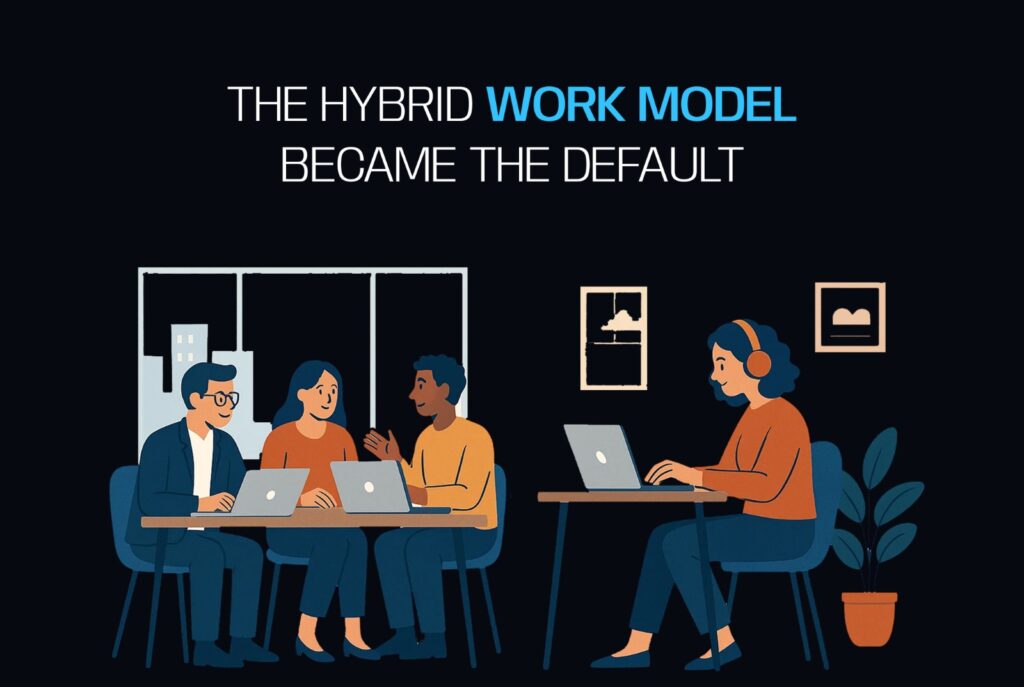
Fully remote turned out not to be what most people wanted. 53% of remote-capable employees are currently in hybrid setups.
The hybrid work model emerged as the practical middle ground, where businesses and employees benefit from flexible workforce solutions that balance deep focus time at home with meaningful face time at the office. Neither extreme won.
Performance Became Harder to Fake
Remote work strips away performative busyness. Either you deliver, or you don’t – and that clarity is actually useful for measuring performance in a real, honest way.
The people coasting on presence get exposed. The genuinely productive people get more credit.
What Stayed the Same
People Still Need People
After five years, the need for face-to-face interaction hasn’t gone away; it’s actually become more important. Most remote workers eventually find themselves seeking out cafes, co-working spaces, or any environment with other people just to feel less disconnected.
The office wasn’t just a place to work; it was a social structure. Remote work doesn’t fulfill this need.
Work-Life Balance Is Still a Mindset Problem
A lot of people assumed working from home would fix their relationship with work. It didn’t. Until you can mentally log off, you carry work with you everywhere.
When home is the office, that line gets harder to hold. Work-life balance is about mindset and boundaries more than location. The people who struggled before 2020 mostly still struggled after. Location changed. The underlying challenge didn’t.
The Return to Office Debate Never Really Ended
Five years in, companies are still fighting about this. In 2025, Amazon, Dell, Apple, Google, X, and dozens of others pushed employees back to the office at least three to five days a week. But employees didn’t quietly comply.
Between early 2024 and late 2025, required office days rose 12%, but actual attendance only increased by 1 to 3%. The return-to-office debate is loud, but the data about the behavior of employees tells a different story.
Trust Is Still the Real Issue
Companies that force people to work from a specific location usually end up with less productivity, not more. Rigid policies make people feel micromanaged. And when people feel micromanaged, they stop going above and beyond.
A results-oriented approach works better than an hours-worked one. The companies that got work-from-home productivity right focused on outcomes. The ones still struggling are managing presence instead of performance.
FAQs
Is remote work actually more productive than working in an office?
Honestly, it depends on the person. Work from home productivity isn’t about where you sit; it’s whether you’ve learned to focus, set boundaries, and deliver no matter the environment.
Some people need the office buzz. Others do their best work in sweatpants alone. But for those who can make remote work work? Remote wins, every time.
Why are companies pushing a return to the office if a hybrid plan works?
Most return-to-office (RTO) mandates aren’t really about productivity data. The return to office debate is less about evidence and more about management culture built around physical presence, and organizations working through a transition that challenges how they’ve always operated.
What does the hybrid work model look like for tech companies in 2026?
For most tech companies, a hybrid work model means two to three days in the office per week, usually anchored around collaboration and team sessions. The rest is remote.
At SOAL Technologies, giving teams ownership over how they structure that time consistently produces better results than prescribing which days people need to show up.
Conclusion
The remote work evolution didn’t produce one winner. Work from home productivity went up for some and down for others. The hybrid work model became the standard not because it’s perfect, but because it’s honest. The return to office debate kept going because trust, not location, was always the real question.
At SOAL Technologies, here’s what we’ve learned from five years of watching work-from-home trends 2026 play out:
- Give people flexibility,
- Judge them on what they actually get done, and
- Stop pretending that being seen at a desk means someone’s working hard.
Everything else? Just noise.
Need the right talent for your team?
Partner with Soal Technologies to access data-driven recruitment solutions that connect you with skilled professionals quickly and efficiently.
Book a Free Consultation